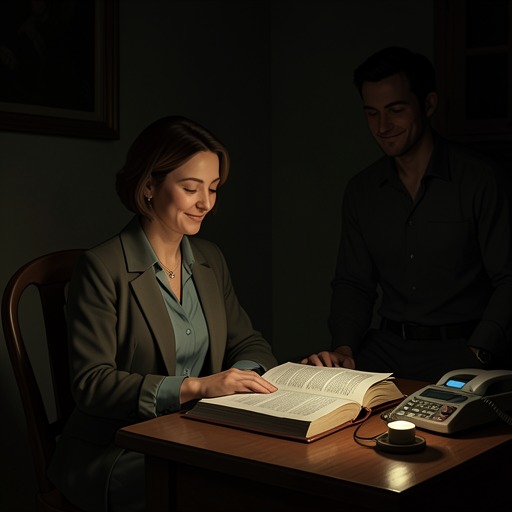
The Bulgarian-born woman and her husband
What Are You Going ThroughThe Bulgarian-born woman and her husband share a forty-year marriage in which long-standing estrangement and practical care coexist. After her diagnosis of metastatic pancreatic cancer, she becomes convinced that her husband is relieved by the prospect of her death, even as he cares for her without complaint. Their relationship, recounted by the friend with cancer who heard the woman’s story in a patient group, resists a simple verdict: the woman recognizes the failures of their marriage, depends on her husband, and sees an emotion in him that others insist cannot be there.
Background and Family
The woman was around sixty and had lived in America since coming there in high school, though she spoke English with an accent. Her husband, born in America to Bulgarian parents, had worked all his life as a buildings inspector before retiring. She was a dental assistant. They had three children, all grown by the time of her illness.
Their marriage began lovingly. The woman recalled the wedding and the children’s births in quick succession as sweet memories, each child healthy and beautiful. In her telling, those early years gave way to a relationship that had ceased to be loving long before the cancer diagnosis. For much of the marriage, the couple did not get along, and the household became so hostile that their children were glad to leave when they were old enough.
Estrangement and Obligation
Once the children had moved out, the couple fought less, but their lives grew increasingly separate. They slept in different rooms, did not always eat together, and could pass whole days exchanging barely a word. The marriage persisted not because the earlier intimacy returned, but because they had made a vow to remain together through better and worse. Their Catholic faith also ruled out divorce for them.
This arrangement left the woman able to describe both the marriage’s misery and the obligations that kept it intact. Their shared history was not simply an account of a once-loving couple pulled together by illness: the distance and resentment had lasted for years. Yet the story does not make the husband’s later care unreal. It places that care inside the same relationship that had become a battleground and then a largely silent coexistence.
Illness and the Husband’s Response
The diagnosis emerged gradually. At first, the woman’s symptoms were attributed to an ulcer, acid reflux, or a pulled muscle; successive tests brought increasingly grave information. Her husband initially reacted with irritation. He told the doctor that she had always been a hypochondriac, a judgment she admitted was not entirely groundless. He also had acid reflux and treated their aches as ordinary troubles of age. When the diagnosis of cancer was confirmed, however, she noticed a change in him.
After the prognosis of metastatic pancreatic cancer had been explained, she believed her husband brightened. Her children suggested that she might be imagining it because of shock, fear, or chemo brain. She rejected those explanations. In the hospital she compared his expression with the sadness and fear she saw on the faces of her children, other relatives, and friends visiting patients. She never saw the same grief in him, she said, and never saw him cry.
One scene fixed her interpretation. When he believed her asleep, she secretly watched him sitting by a hospital window, legs crossed and one foot swinging as he looked toward the sky. She read his expression as contentment. He then stretched his legs, leaned back with his hands behind his neck, studied the ceiling, sighed, and smiled. To her, the sequence was not the concealed sorrow others claimed to see; it suggested that he felt released from the marriage. She imagined his heart singing with freedom.
Care, Silence, and Conflicting Readings
The woman wanted to tell her husband not to visit the hospital and to tell him that she could read his feelings after forty years. She did not confront him. She lacked the courage, she said, and felt ashamed of him and sorry for him at once. She also considered a possibility that made her judgment less absolute: perhaps he did not understand his own response and was in denial about it. The story leaves that possibility unresolved rather than supplying the husband’s account.
She could understand, too, why someone trapped in an unhappy marriage might feel relief when the other person was dying. Had their positions been reversed, she thought, she might have felt the same. She therefore questioned whether the wrong lay in his emotion itself, or in his inability to conceal it. Her account holds anger, pity, shame, and recognition together; it does not turn her into a disinterested judge of a marriage she herself describes as miserable.
At the same time, she needed him. Ill and often helpless, she did not want her children, each with a job, family, and difficulties of their own, to bear the whole burden of caring for her. Her husband did take care of her, though it was not always easy, and did so without complaining. He was now cheerful around her, readily doing things for her and sometimes humming or whistling. That attentiveness did not persuade her that he loved her, or erase what she believed she had seen. In her account, care and apparent relief occupy the same domestic space.
The Story in the Patient Group
The friend with cancer heard this account in a patient-only group held at a cancer clinic, where no therapist or other trained leader was present. The woman told it in a stilted, monotonous manner, eyes lowered as if following an invisible script. The group listened closely, but several members then rejected her reading. They proposed that her husband was putting on a cheerful face to help her maintain her spirits, and treated his helpfulness as proof of love. The woman did not argue. She nodded occasionally, kept her eyes down, and maintained a crooked half-smile; the friend understood her silence as certainty that she knew what she knew.
For the friend, the group’s reassurance became a form of denial. She saw the woman as having named an unwelcome truth, while the other patients covered it with a more consoling interpretation. Their response echoed the familiar insistence that positive thinking, miracles, or a cheerful performance can make illness easier to face. The friend connected this dismissal to other occasions when people had assured her that a daughter who did not show love must nevertheless love her mother. In both cases, a listener’s comforting general rule displaced what the person describing the relationship said she experienced.
The woman’s eventual death renewed the friend’s anger and shame. She wondered whether anyone had truly seen the woman before the end, but the story gives no answer about whether she later confronted her husband or how he understood their marriage. That absence matters: the relationship reaches the reader through the woman’s account, preserved by a friend who was troubled by the group’s refusal to hear it. The marriage therefore remains both a particular history of estrangement and care and a test of whether listening means accepting a painful account without replacing it with a kinder one.